Erectile Dysfunction • PDE5 Inhibitor

Tadalafil Daily vs On‑Demand: Practical Comparison & Key Insights

This page explains how tadalafil works in daily vs on‑demand regimens and why men experience different timing, onset, and duration depending on the dosing strategy. Daily tadalafil provides a steady baseline level for spontaneous activity, while on‑demand dosing offers a flexible, event‑based approach. Learn how timing changes in Timing, how fast tadalafil can start working in Onset, and why its long window of action is detailed in Duration.

Explore how food affects absorption in Food Interaction, how alcohol modifies performance in Alcohol Interaction, and what to do if the medication feels inconsistent in Troubleshooting. Long‑term considerations are covered in Long‑Term Use, with specific guidance for younger men in Younger Men.

Daily vs On‑Demand: Overview
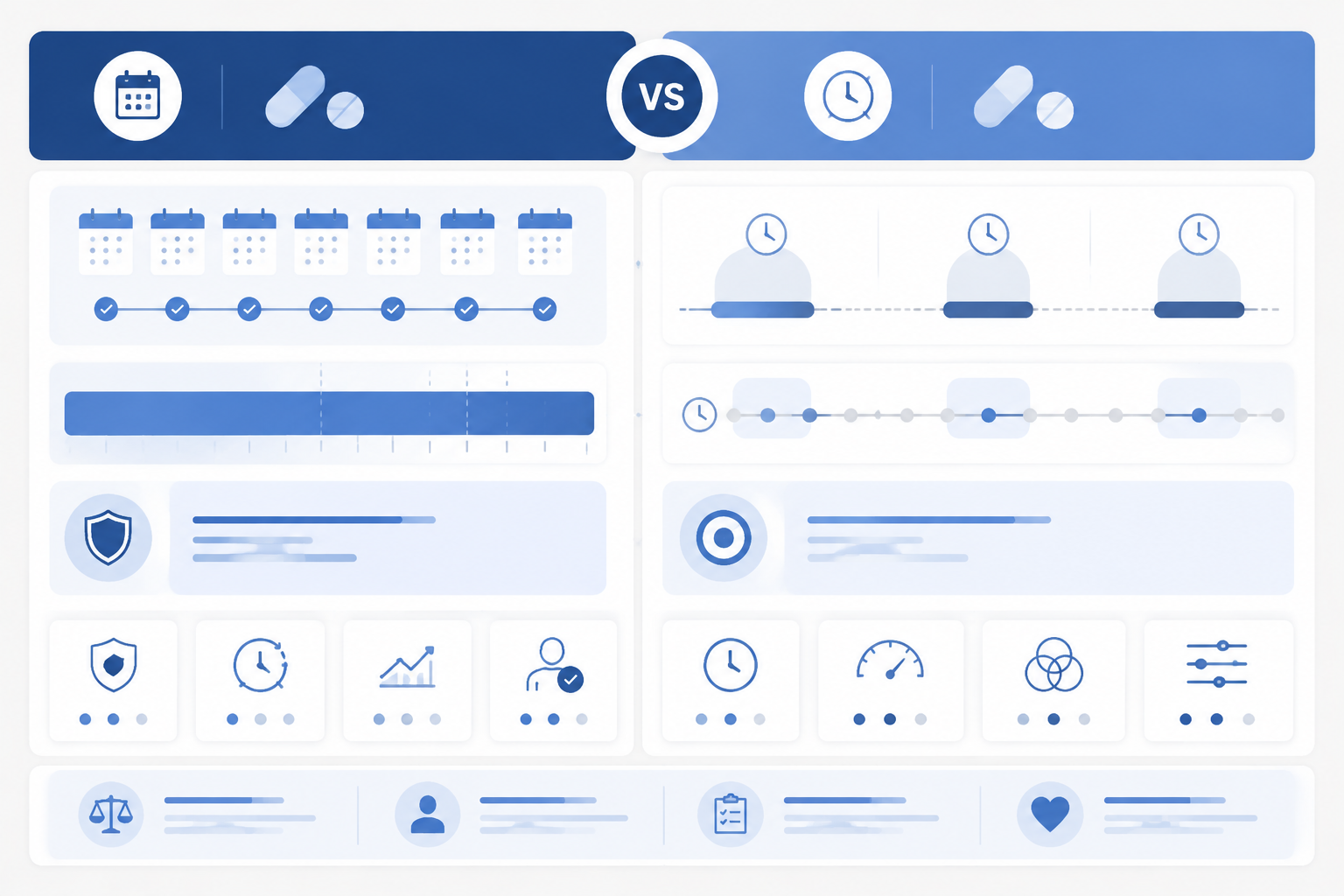
Tadalafil Daily vs On‑Demand

Tadalafil can be used in two distinct regimens — daily and on‑demand — each offering different practical advantages depending on how predictable or flexible a patient wants their sexual activity to be. The daily regimen maintains a stable plasma level of tadalafil, reducing reliance on precise timing and minimizing performance‑related stress. Because the drug remains consistently active, onset becomes less noticeable, and the experience feels more spontaneous.

In contrast, the on‑demand approach depends heavily on onset and timing accuracy. Men typically take the dose before anticipated activity, which means absorption, food interactions (Food), and alcohol (Alcohol) can influence how quickly the effect appears. This regimen suits those who prefer episodic use but requires more attention to timing and situational factors.

A third informational concept — the hybrid model — combines daily dosing with occasional on‑demand boosts. While not a formal clinical regimen, it helps illustrate how patients may adapt tadalafil to different scenarios. Each approach offers unique informational benefits, from reduced timing pressure to flexible event‑based use, and deeper guidance is available in sections such as Duration, Troubleshooting, Long‑Term Use, and Younger Men.

Regimen Key Feature General Notes
Daily Stable levels Minimal timing stress
On‑demand Flexible use Timing matters
Hybrid Daily + occasional boost Informational concept

Timing Differences

Timing is one of the most noticeable distinctions between tadalafil’s daily and on‑demand regimens. In a daily regimen, tadalafil maintains stable plasma levels, meaning men do not need to calculate or anticipate the exact moment when the medication will become active. This eliminates timing pressure and allows sexual activity to occur spontaneously without planning. Because the drug is already present in the system, timing becomes largely irrelevant, and the experience feels more natural.

In contrast, the on‑demand regimen requires attention to onset and timing. Men typically take tadalafil before anticipated activity, and the effect depends on how quickly the medication reaches effective levels. Factors such as absorption rate, metabolic variability, and situational elements influence timing, making onset a key consideration. More detailed guidance is available in the Timing section.

A flexible informational model also exists, where users rely on tadalafil’s long duration to create a broader timing window. This approach highlights how tadalafil’s pharmacokinetics support both structured and spontaneous use depending on individual preference.

Regimen Timing Requirement Notes
Daily None Stable levels
On‑demand 1–2 hours Onset matters
Flexible 1–4 hours Long duration supports flexibility

Onset Differences

Onset varies significantly between daily and on‑demand tadalafil use. With a daily regimen, tadalafil maintains a continuous therapeutic level, producing a smooth, almost unnoticeable onset. There is no distinct “kick‑in” moment because the medication is already active in the bloodstream. This creates a more spontaneous experience and reduces the psychological focus on onset timing.

In the on‑demand regimen, onset becomes a central factor. Most users experience onset within the typical informational range, but variability is common. Food intake, especially heavier meals, can mildly delay absorption, while alcohol may shift perceived onset. Metabolic differences also play a role, making onset less predictable than in daily use. Detailed onset guidance is available in the Onset section.

After meals, onset may extend toward the upper end of the range, illustrating how situational factors influence the pharmacodynamic response. Understanding these differences helps users choose the regimen that aligns best with their expectations and lifestyle.

Regimen Typical Onset Notes
Daily Continuous No kick‑in phase
On‑demand 45–120 minutes Standard informational range
After meal 60–120 minutes Mild delay

Duration Differences

Duration is another major distinction between daily and on‑demand tadalafil use. The daily regimen provides a continuous window of action, ensuring that tadalafil remains active at all times. This stable effect eliminates the need to consider duration limits and supports spontaneous sexual activity throughout the day and night. Because plasma levels remain consistent, the duration feels seamless rather than episodic.

The on‑demand regimen typically offers a 24–36‑hour window, which is one of tadalafil’s most recognized advantages. This extended duration allows flexibility across multiple time periods without requiring repeated dosing. For many users, this long window reduces timing pressure while still maintaining an event‑based approach.

Some individuals experience an extended duration of 36–48 hours due to metabolic variability. While not guaranteed, this informational range highlights tadalafil’s long pharmacokinetic tail. More detailed duration guidance is available in the Duration section.

Regimen Duration Window General Notes
Daily Continuous Stable effect
On‑demand 24–36 hours Most users
Extended 36–48 hours Individual variability

Daily Regimen: Informational Advantages

The daily regimen offers several informational advantages that make it appealing for users who prefer predictability and minimal planning. Because tadalafil maintains stable plasma levels, the effect remains consistent throughout the day, reducing variability and ensuring a reliable response. This stability eliminates timing‑related stress, as there is no need to anticipate or calculate when the medication will become active. Sexual activity can occur spontaneously, without the pressure of coordinating onset or timing windows.

Daily use is often highlighted as particularly convenient for individuals with irregular or highly variable schedules. Those who cannot reliably predict when sexual activity may occur benefit from the continuous therapeutic window, which removes the need for pre‑event dosing. The smoother onset associated with daily tadalafil also contributes to a more natural experience, as there is no distinct “kick‑in” phase. Additional long‑term considerations and informational guidance are available in the Long‑Term Use section.

Overall, the daily regimen provides a simplified, low‑stress approach that supports spontaneity, consistency, and ease of use. Its predictable pharmacokinetic profile makes it a strong informational option for users seeking stability rather than episodic dosing.

Advantage Description General Notes
Stable levels Consistent effect Minimal variability
No timing stress No need to plan Useful for flexible schedules
Smoother onset No kick‑in phase Continuous window

On‑Demand Regimen: Informational Advantages

The on‑demand regimen provides flexibility for users who prefer taking tadalafil only when needed. This approach eliminates daily intake and allows individuals to use the medication in specific situations, making it suitable for those with infrequent sexual activity or those who prefer a non‑routine schedule. Because dosing is event‑based, users can tailor intake to their personal circumstances without committing to continuous therapy.

On‑demand use is often described as advantageous for people who want minimal medication exposure or who do not require consistent daily readiness. The long duration of tadalafil — typically 24–36 hours — supports a broad activity window even with episodic dosing, offering flexibility across multiple time periods. More detailed troubleshooting and informational guidance for on‑demand users are available in the Troubleshooting section.

Overall, the on‑demand regimen provides a simple, situationally adaptive option that aligns well with users who value flexibility, minimal routine, and targeted use rather than continuous coverage.

Advantage Description General Notes
Flexible use Only when needed Useful for infrequent activity
No daily intake Less routine Simple schedule
Long window 24–36 hours Supports flexibility

Frequently Asked Questions

Daily tadalafil maintains a continuous level in the body, creating a stable and spontaneous experience without timing pressure. On‑demand tadalafil is taken before anticipated activity and depends on onset, absorption, and situational factors. Both regimens offer different informational advantages depending on lifestyle and expectations.

Daily tadalafil provides a steady therapeutic level, reducing variability and eliminating the need to anticipate when the effect will begin. Because there is no distinct kick‑in phase, users often describe the experience as smoother and more predictable. This stability supports spontaneous activity and minimizes timing‑related stress.

Food has little impact on daily tadalafil because the medication is already active in the system. In on‑demand use, heavier meals may slow absorption and shift perceived onset. This difference makes food more relevant for episodic dosing, where timing and onset play a larger informational role.

Alcohol may influence how users perceive onset and timing in on‑demand dosing, especially when taken close to the planned activity window. In daily use, the effect window is more stable, so alcohol typically has less noticeable impact. Differences mainly relate to timing sensitivity rather than overall duration.

Common mistakes include choosing on‑demand dosing despite unpredictable schedules, expecting immediate onset without considering timing, or assuming daily use is necessary for infrequent activity. Another frequent issue is overlooking how lifestyle factors influence timing and onset. Understanding regimen differences helps avoid mismatched expectations.

Informational sources often emphasize daily regimen effectiveness because stable levels reduce timing pressure and create a smoother experience. Daily use supports spontaneity and minimizes variability, making it easier to understand and describe. These advantages make the regimen appealing for users with flexible or unpredictable schedules.