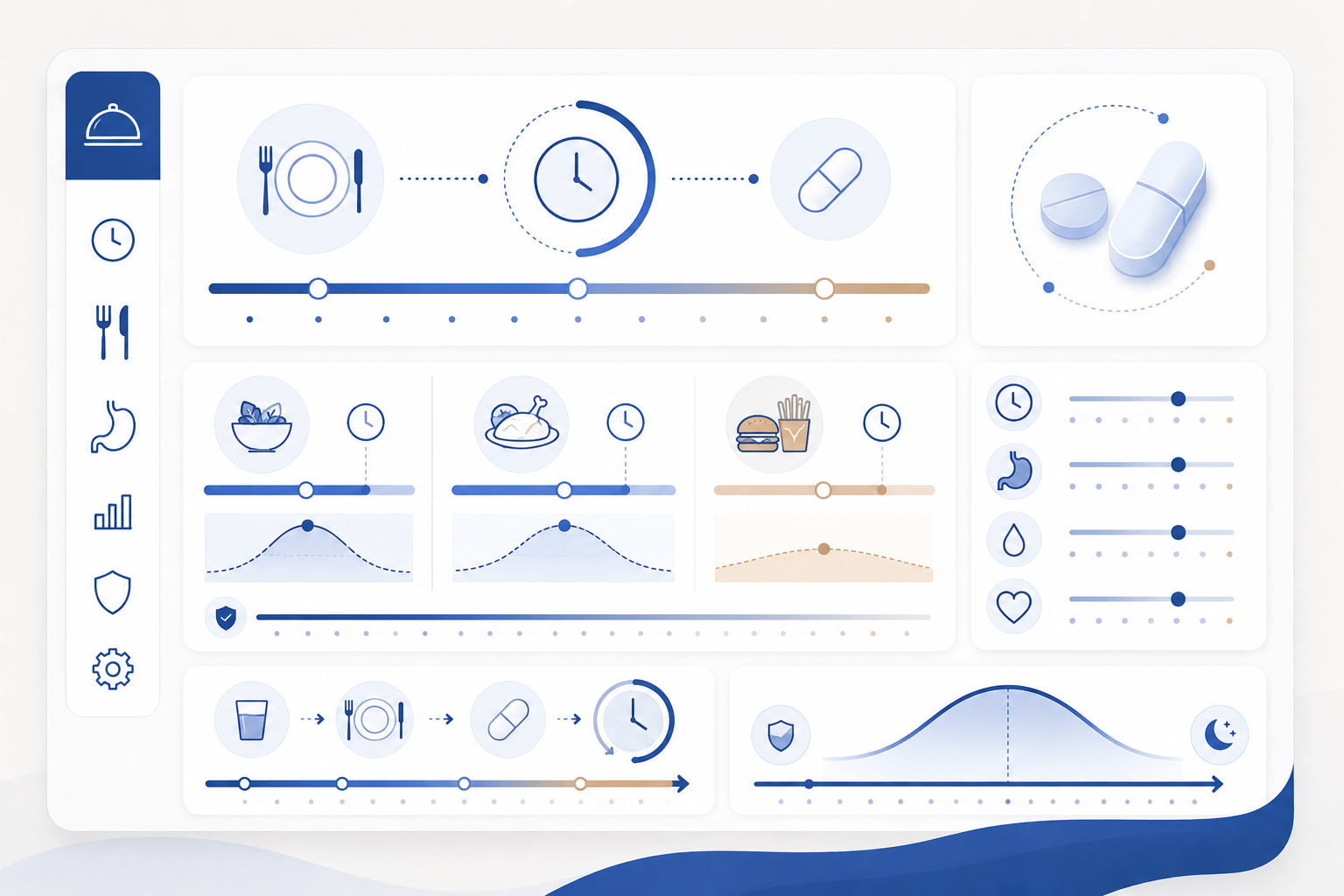
This page explains tadalafil food interaction and how meals influence tadalafil absorption, onset, and real‑world timing. Tadalafil is notably less sensitive to food than sildenafil, yet meal type and timing still shape how quickly the effect appears. Users often ask about tadalafil with food and tadalafil after meal scenarios — from empty stomach to standard meals and high‑fat dinners.
For deeper timing guidance, explore Tadalafil Timing and onset details in Onset. Duration insights are available in Duration, while alcohol interaction is covered in Alcohol. If tadalafil feels slower than expected, review common causes in Not Working and compare flexible use patterns in Daily vs On‑Demand.
Tadalafil demonstrates a notably stable absorption profile, and its interaction with food is milder compared with sildenafil. While meals can influence how quickly tadalafil reaches effective plasma levels, the overall pharmacokinetics remain consistent across most dietary scenarios. This makes tadalafil a preferred option for users who want predictable onset and flexible timing without strict meal‑related restrictions. Still, understanding how different meal types affect absorption helps optimize real‑world use and avoid unnecessary delays.
On an onset level, taking tadalafil on an empty stomach typically results in faster absorption and a slightly quicker response. A standard meal produces minimal delay, and most users do not notice any meaningful timing shift. High‑fat meals may slow absorption modestly, but the effect is significantly weaker than with sildenafil. These differences matter most for users who rely on precise timing or who monitor subtle changes in onset during repeated use.
Overall, food interaction with tadalafil is clinically mild, yet understanding these patterns helps refine expectations and troubleshoot situations where the medication feels slower than usual. For broader context, see Duration, alcohol interaction in Alcohol, and troubleshooting guidance in Not Working.
| Meal Type | Absorption Impact | General Notes |
|---|---|---|
| Empty stomach | Fast absorption | Often faster onset |
| Standard meal | Minimal delay | Onset usually unchanged |
| High‑fat meal | Mild delay | Less impact than sildenafil |
Taking tadalafil after a meal generally produces only mild changes in absorption and onset. The drug’s pharmacokinetics remain stable across most dietary conditions, and standard meals rarely cause any noticeable delay. This is one of the reasons tadalafil is considered more flexible than sildenafil, which shows stronger sensitivity to food and especially to high‑fat meals. For most users, the post‑meal window does not significantly alter how quickly tadalafil begins working.
When tadalafil is taken immediately after eating, a slight slowdown in absorption may occur, but the effect is usually subtle. Waiting about an hour after a standard meal typically results in near‑normal onset, with minimal timing shift. By the 2–3 hour mark, absorption resembles an empty‑stomach scenario, making timing more predictable. These patterns matter for users who closely track onset or adjust their routine based on timing expectations.
Overall, meal timing influences tadalafil onset, but the effect is weaker than with other PDE5 inhibitors. Users who experience occasional slow onset can review broader factors in Not Working or explore flexible use strategies in Daily vs On‑Demand.
| Meal Timing | Typical Effect | Notes |
|---|---|---|
| Immediately after meal | Mild delay | Absorption slows slightly |
| 1 hour after meal | Minimal delay | Onset usually stable |
| 2–3 hours after meal | Negligible impact | Close to empty stomach |
Fatty meals can influence tadalafil absorption, but the effect is noticeably weaker than with sildenafil. High‑fat foods slow gastric emptying, which can slightly delay how quickly tadalafil reaches effective plasma levels. While this delay is usually mild, it may contribute to occasional “slow onset” experiences, especially in users who expect rapid response or who take the medication immediately after heavy food intake.
Typical real‑world scenarios include heavy dinners, fast‑food meals, and high‑fat snacks. A heavy dinner may produce a mild delay, though still far less than what is commonly observed with sildenafil. Fast food can cause mild to moderate slowdown depending on fat content and portion size. High‑fat snacks generally create only a small shift in onset, but sensitive users may still notice subtle timing differences. These patterns are relevant for users monitoring onset or troubleshooting timing issues via Not Working.
Overall, fatty meals do not critically affect tadalafil, but they can introduce slight variability in onset. For broader timing context, see Tadalafil Timing and duration insights in Duration.
| Fatty Meal Type | Impact on Onset | General Notes |
|---|---|---|
| Heavy dinner | Mild delay | Less impact than sildenafil |
| Fast food | Mild to moderate delay | Absorption varies |
| High‑fat snacks | Mild delay | Onset may shift slightly |
Many informational sources highlight recurring mistakes users make when interpreting tadalafil’s food interaction profile. Although tadalafil is far less sensitive to food than sildenafil, some users assume that meals — including heavy or high‑fat meals — have zero impact. This misunderstanding often leads to unrealistic expectations, especially when tadalafil is taken immediately after a large dinner. The delay is usually mild, but it can still shift onset enough for users to perceive slower response.
Another common mistake involves incorrect timing. Because tadalafil has a long duration, users may misjudge the optimal window and assume that timing does not matter at all. While tadalafil is flexible, meal timing can still influence onset slightly, especially in sensitive individuals. Comparing tadalafil directly with sildenafil is also a frequent error: sildenafil shows strong food sensitivity, whereas tadalafil’s interaction is much weaker — but not entirely absent.
These mistakes are widely mentioned across informational resources and often appear in troubleshooting discussions. Users who experience inconsistent onset or suspect food‑related delays can explore detailed guidance in Tadalafil Not Working, where broader timing, onset, and lifestyle factors are explained.
| Mistake | Common Cause | General Informational Note |
|---|---|---|
| Expecting no delay after heavy meal | Misunderstanding food impact | Delay is mild but possible |
| Incorrect timing | Misjudged window | Long duration allows flexibility |
| Comparing with sildenafil | Different food sensitivity | Tadalafil is less affected |
Food generally causes only mild changes in tadalafil absorption. Standard meals rarely produce a noticeable delay, and most users experience similar onset regardless of typical eating patterns. Heavy or high‑fat meals may slow absorption slightly, but the effect is far weaker than with medications that show strong food sensitivity.
Fatty meals can slow gastric emptying, which may slightly delay tadalafil’s onset. The shift is usually mild and not clinically significant, but some users may perceive slower response after heavy dinners or fast‑food meals. Overall, the impact remains modest and does not meaningfully change tadalafil’s broader performance profile.
Tadalafil can be taken with or without food because its absorption is stable across most meal types. Many users take it alongside regular meals without noticing any difference in onset. Only very heavy or high‑fat meals may introduce a slight delay, but typical eating patterns do not meaningfully affect its timing.
Food effects are most noticeable immediately after eating, especially following heavy or high‑fat meals. After about one hour, any delay becomes minimal, and by the two‑to‑three‑hour mark, absorption resembles an empty‑stomach scenario. These timing patterns help explain occasional variations in onset without indicating major interaction.
Common mistakes include assuming heavy meals have zero impact, misjudging the timing window, and comparing tadalafil directly with sildenafil. These misunderstandings often lead to unrealistic expectations about onset. While tadalafil is less sensitive to food, mild delays can still occur, especially when taken right after large or high‑fat meals.
Meal timing mainly affects onset rather than duration. Even when absorption is slightly slower after heavy meals, tadalafil’s long activity window remains stable. Users may notice a shift in how quickly it begins working, but the overall duration is generally unchanged across different eating patterns.