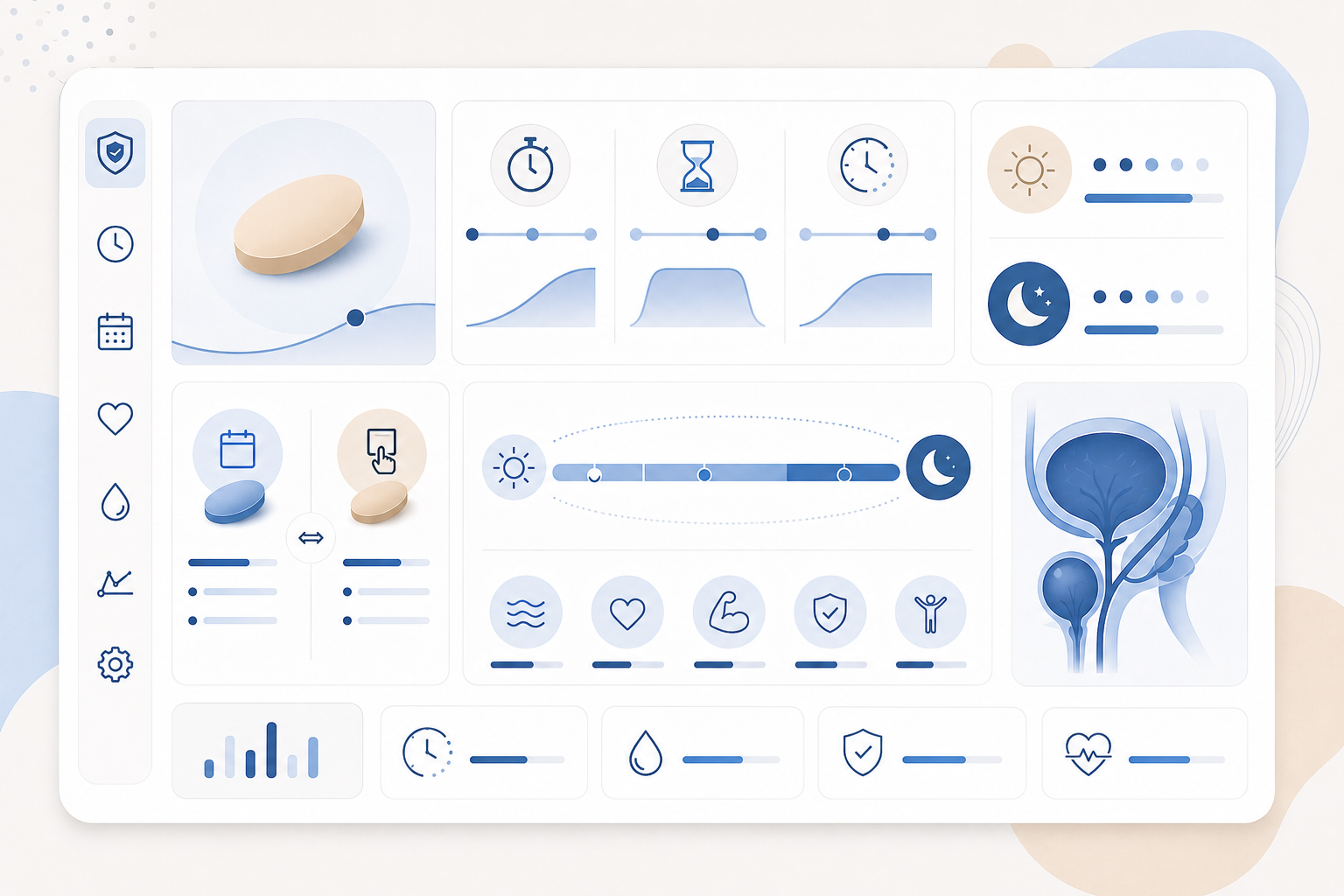
Tadalafil is a long‑acting PDE5 inhibitor known for its extended duration and flexible dosing options. This practical guide explains how tadalafil works in real‑world use and helps men choose between daily and on‑demand strategies. The page covers essential topics such as timing, onset, duration, food and alcohol interaction, common mistakes, and troubleshooting steps.
Review timing in Tadalafil Timing, understand onset in Onset, and explore its long duration in Duration. Learn how meals affect absorption in Food Interaction and how alcohol influences performance in Alcohol Interaction. Compare dosing strategies in Daily vs On‑Demand, fix issues in Not Working, understand long‑term use in Long‑Term, and see specific guidance for younger men in Younger Men.
Tadalafil offers one of the most flexible timing profiles among PDE5 inhibitors, making it easier for men to plan sexual activity without the strict intake windows required by sildenafil or vardenafil. Most users take tadalafil 1–2 hours before intercourse, but its long half‑life allows a much broader effective window. This flexibility is the main reason tadalafil is preferred by men who want less time‑pressure and more spontaneity. A detailed breakdown is available on the Tadalafil Timing page.
Timing mistakes are common. Many men take tadalafil too close to activity, expecting an immediate response, or assume that food and mild alcohol have no influence at all. Others switch between daily and on‑demand dosing without understanding how blood levels accumulate. Recognizing these timing errors helps improve consistency and reduces the perception that tadalafil is “not working.”
Because tadalafil maintains stable plasma levels for many hours, early intake—sometimes even several hours before activity—remains effective. This extended window is what differentiates tadalafil from shorter‑acting PDE5 inhibitors and supports both planned and spontaneous use.
| Timing Window | Typical Range | Notes |
|---|---|---|
| Recommended Intake | 1–2 hours before activity | Flexible window due to long duration |
| Daily Use | Same time each day | Stable blood levels |
| Early Intake | 2–4 hours | Still effective due to long half‑life |
Onset refers to the time it takes for tadalafil to begin producing a noticeable erectile response after ingestion. Unlike sildenafil or vardenafil, tadalafil often shows a slower and more gradual onset because of its longer half‑life and smoother pharmacokinetic curve. Most men fall within a broad 45–120‑minute window, although some experience earlier effects. A detailed breakdown is available on the Tadalafil Onset page.
Several factors influence how quickly tadalafil begins working. Individual metabolism plays a major role: faster metabolizers may feel effects sooner, while slower metabolizers may require more time. Food intake—especially heavy or high‑fat meals—can delay absorption and shift onset later. Regular daily use creates stable plasma levels, reducing variability and making onset feel more continuous rather than tied to a single dose. These differences explain why tadalafil’s onset is less abrupt and more predictable over time.
| Onset Category | Typical Time | Influencing Factors |
|---|---|---|
| Fast Onset | 30–45 minutes | Empty stomach, individual metabolism |
| Standard Onset | 45–120 minutes | Most users |
| Daily Use Onset | Continuous | Stable levels reduce variability |
Tadalafil is widely known for its exceptionally long duration of action, which distinguishes it from shorter‑acting PDE5 inhibitors. Most men experience a functional window of 24–36 hours, often referred to as the “weekend pill” range. This extended duration is the result of tadalafil’s long half‑life and stable vascular response profile. A full explanation is available on the Tadalafil Duration page.
Duration varies based on metabolism, vascular sensitivity, food intake, and whether tadalafil is used daily or on‑demand. Faster metabolizers may fall closer to the standard range, while slower metabolizers or men with strong vascular responsiveness may experience effects lasting up to 48 hours. Daily dosing produces continuous coverage, eliminating peaks and troughs and creating a stable effect window. These factors explain why tadalafil’s duration is not fixed and can shift significantly between individuals.
| Duration Range | Typical Window | Notes |
|---|---|---|
| Standard | 24–36 hours | Most common informational range |
| Extended | 36–48 hours | Individual variability |
| Daily Use | Continuous | Stable effect window |
Food and alcohol can influence how tadalafil is absorbed and perceived, but the medication remains notably less sensitive to meals compared with shorter‑acting PDE5 inhibitors such as sildenafil or vardenafil. Most informational sources describe tadalafil as highly stable across different dietary conditions, with only mild shifts in onset when taken after heavy or high‑fat meals. A detailed breakdown of meal effects is available on the Tadalafil Food Interaction page.
High‑fat meals may slow gastric emptying, causing a slight delay in absorption, but this delay is usually minimal and does not meaningfully change the overall onset window. Standard meals have negligible impact, which is why tadalafil is often preferred by men who want predictable performance regardless of eating patterns. Alcohol, however, introduces a different type of interaction: its vasodilatory effect can overlap with tadalafil’s mechanism, sometimes creating a perceived reduction in erectile firmness. More details are provided on the Tadalafil Alcohol Interaction page.
Overall, tadalafil maintains a stable pharmacokinetic profile across most real‑world scenarios. Understanding how food and alcohol influence absorption and perception helps reduce timing mistakes and improves consistency during use.
| Interaction Type | Effect | Typical Outcome |
|---|---|---|
| High‑fat Meal | Minimal absorption delay | Onset usually unchanged |
| Standard Meal | Negligible impact | Stable onset |
| Alcohol | Vasodilation overlap | Possible perceived reduction |
Tadalafil can be taken either daily or on‑demand, and informational sources frequently highlight the practical differences between these two approaches. Daily use maintains stable blood levels, producing a continuous effect window with minimal variability in onset. This stability reduces timing stress and is often preferred by men who want predictable readiness without planning intake around sexual activity. A full comparison is available on the Daily vs On‑Demand page.
On‑demand use offers flexibility: men take tadalafil only when needed, typically 1–2 hours before intercourse. Because tadalafil has a long duration, on‑demand dosing still supports spontaneity and allows a wide functional window. However, onset may vary more compared with daily use, especially if meals, alcohol, or inconsistent timing are involved. Informational sources often note that men who experience fluctuating onset or inconsistent results may benefit from switching to daily dosing.
Each regimen has advantages and limitations. Daily use provides stability and reduces variability, while on‑demand use minimizes medication exposure and suits men with less frequent sexual activity. Understanding these differences helps users choose the most appropriate strategy for their needs.
| Use Type | Characteristics | Notes |
|---|---|---|
| Daily | Stable levels, continuous window | Less timing stress |
| On‑Demand | Flexible intake | Long duration supports flexibility |
Troubleshooting tadalafil involves understanding why the effect may feel weak, inconsistent, or absent. Informational sources frequently mention timing mistakes, food‑related delays, alcohol overlap, and individual metabolic differences as the most common contributors. Many men take tadalafil too close to sexual activity, expecting an immediate response, or assume that meals and alcohol have no influence at all. A full breakdown of typical issues is available on the Tadalafil Not Working page.
Perceived “no effect” often results from incorrect timing: tadalafil’s onset varies widely, and some users underestimate the 45–120‑minute window. Weak effect is frequently associated with alcohol, which can reduce vascular responsiveness and create a softer perceived impact. Delayed onset is commonly linked to individual metabolism, especially in men who take tadalafil inconsistently or switch between daily and on‑demand use without understanding how blood levels accumulate.
Other factors include heavy meals, stress, fatigue, and unrealistic expectations about how quickly tadalafil should work. Daily use typically reduces variability and helps stabilize onset, which is why informational sources often recommend evaluating consistency before assuming the medication is ineffective. Understanding these patterns helps users identify avoidable mistakes and improve real‑world results.
| Issue | Common Cause | General Informational Note |
|---|---|---|
| No effect | Incorrect timing | Onset varies widely |
| Weak effect | Alcohol | May reduce perceived impact |
| Delayed onset | Individual metabolism | Daily use reduces variability |
Tadalafil’s performance can vary across different user groups, particularly younger men and those using the medication long‑term. Younger men often report more variable onset perception, partly due to higher baseline erectile responsiveness and lifestyle factors such as irregular sleep, stress, or alcohol intake. Despite this variability, tadalafil’s long duration supports flexibility and allows a wide functional window. More details are available on the Tadalafil for Younger Men page.
Long‑term use is frequently associated with stable blood levels and reduced timing variability. Informational sources often note that men who use tadalafil consistently experience smoother onset, fewer fluctuations, and more predictable results. This stability is one of the main advantages of daily or long‑term regimens, especially for users who prefer readiness without planning intake around sexual activity. A full overview is provided on the Tadalafil Long‑Term Use page.
Understanding how tadalafil behaves in these groups helps clarify why experiences differ and why some men benefit from daily use while others prefer on‑demand dosing. Lifestyle, metabolism, and dosing consistency remain key factors shaping real‑world perception of effect.
| Group | Common Considerations | Notes |
|---|---|---|
| Younger Men | Variable onset perception | Long duration supports flexibility |
| Long‑Term Use | Stable levels | Reduced timing variability |
Most informational sources describe tadalafil as typically taken 1–2 hours before activity, though its long duration allows a wider practical window. Many users report that early intake feels more predictable, especially when timing varies. This flexibility is one of the main reasons tadalafil is preferred for spontaneous use.
Onset differences are usually linked to metabolism, lifestyle factors, and dosing consistency. Some users absorb tadalafil faster, while others experience slower activation due to meals, alcohol, or irregular intake patterns. Daily use often reduces variability, making onset feel smoother and more predictable over time.
Food generally has minimal impact on tadalafil absorption, which is why it is considered meal‑flexible. Heavy or high‑fat meals may slow gastric emptying slightly, but most users do not notice meaningful changes in onset. This stability differentiates tadalafil from shorter‑acting PDE5 inhibitors.
Alcohol can influence perceived effectiveness because its vasodilatory effects may overlap with tadalafil’s action. This overlap can make erections feel weaker or less consistent, even though the medication is still active. Mild intake usually has limited impact, but heavier drinking often reduces perceived firmness.
Frequent mistakes include taking tadalafil too close to activity, assuming immediate onset, ignoring the influence of alcohol, and switching between daily and on‑demand use without understanding how blood levels accumulate. Stress, fatigue, and unrealistic expectations also affect how the effect is perceived.
Tadalafil’s extended duration is primarily due to its long half‑life and stable pharmacokinetic profile. These characteristics allow the medication to maintain effective plasma levels for many hours, creating a wide functional window. This long‑acting behavior is a key distinction from shorter‑acting PDE5 options.